Evelyn McHale | ‘The Most Beautiful Suicide’ Photograph

On May Day, just after leaving her fiancĂ©, 23-year-old Evelyn McHale wrote a note. ‘He is much better off without me … I wouldn’t make a good wife for anybody,’ … Then she crossed it out. She went to the observation platform of the Empire State Building. Through the mist she gazed at the street, 86 floors below. Then she jumped. In her desperate determination she leaped clear of the setbacks and hit a United Nations limousine parked at the curb. Across the street photography student Robert Wiles heard an explosive crash. Just four minutes after Evelyn McHale’s death Wiles got this picture of death’s violence and its composure. The serenity of McHale’s body amidst the crumpled wreckage it caused is astounding. Years later, Andy Warhol appropriated Wiles’ photography for a print called Suicide (Fallen Body).


Evelyn McHale | ‘The Most Beautiful Suicide’ (Life Magazine, 1947) Photo by Robert C. Wiles


Evelyn, still clutching a pearl necklace, looks disarmingly placid and composed – as if simply asleep. Around her, however, the broken glass and crumpled sheet metal of a car roof show the brutally destructive evidence of her 1050 ft jump. Some 60 years later the photo remains as haunting and affecting as when it was first published.
Around 10:40 am Patrolman John Morrissey, directing traffic at Thirty-fourth Street and Fifth Avenue, noticed a white scarf floating down from the upper floors of the building. Moments later he heard a crash and saw a crowd converge on 34th street. Evelyn had jumped, cleared the setbacks, and landed on the roof of a United Nations Assembly Cadillac limousine parked on 34th street, some 200 ft west of Fifth Ave.
Across the street, Robert C. Wiles, a student photographer, also noticed the commotion and rushed to the scene where he took several photos, including this one, some four minutes after her death. Later, on the observation deck, Detective Frank Murray found her tan (or maybe gray, reports differ) cloth coat neatly folded over the observation deck wall, a brown make-up kit filled with family pictures and a black pocketbook with the note which read:
“I don’t want anyone in or out of my family to see any part of me. Could you destroy my body by cremation? I beg of you and my family – don’t have any service for me or remembrance for me. My fiance asked me to marry him in June. I don’t think I would make a good wife for anybody. He is much better off without me. Tell my father, I have too many of my mother’s tendencies.. [via codex99.com]

Andy Warhol ~Suicide (Fallen Body). 1962


May, 1947 issue of LIFE Magazine

Evelyn incorrectly reported to be 20 years old. ( she was 23)
NY Times, May 2, 1947

Codex 99 did some research on McHale and her activities on the day she died.


You have read this article Andy Warhol / Evelyn McHale / life magazine / Robert Wiles / The Most Beautiful Suicide with the title . You can bookmark this page URL https://nikiinwonderland.blogspot.com/2012/11/evelyn-mchale-most-beautiful-suicide.html. Thanks!

Never-Before-Seen Contact Sheets from Stanley Kubrick's First Movie and His Photographs of Heavyweight Champ Rocky Graziano

From Photography to Film: Stanley Kubrick Enters the Ring

"Although Kubrick is regarded as the most critically and commercially successful photographer turned full-time feature filmmaker (and my personal favourite director), this mainstream acclaim might also be the reason his name rarely enters the discussion of the legendary New York-based photographers and their progressive contributions to avant garde and non-narrative filmmaking. This tradition includes Paul Strand (Manhatta, 1921), Rudy Burckhardt (The Pursuit of Happiness, 1940) Helen Levitt (In the Street, 1949), Ruth Orkin & Morris Engel (The Little Fugitive, 1953), William Klein (Broadway by Light, 1958) and Robert Frank (Pull My Daisy, 1959), among whose varying innovations include discrete handheld photography, examples of “life caught unawares,” and blurring lines between documentary and staged situations."[via Time Lightbox]

Read more: http://lightbox.time.com/2012/11/01/from-photography-to-film-stanley-kubrick-enters-the-ring/#ixzz2AzUcsvGk
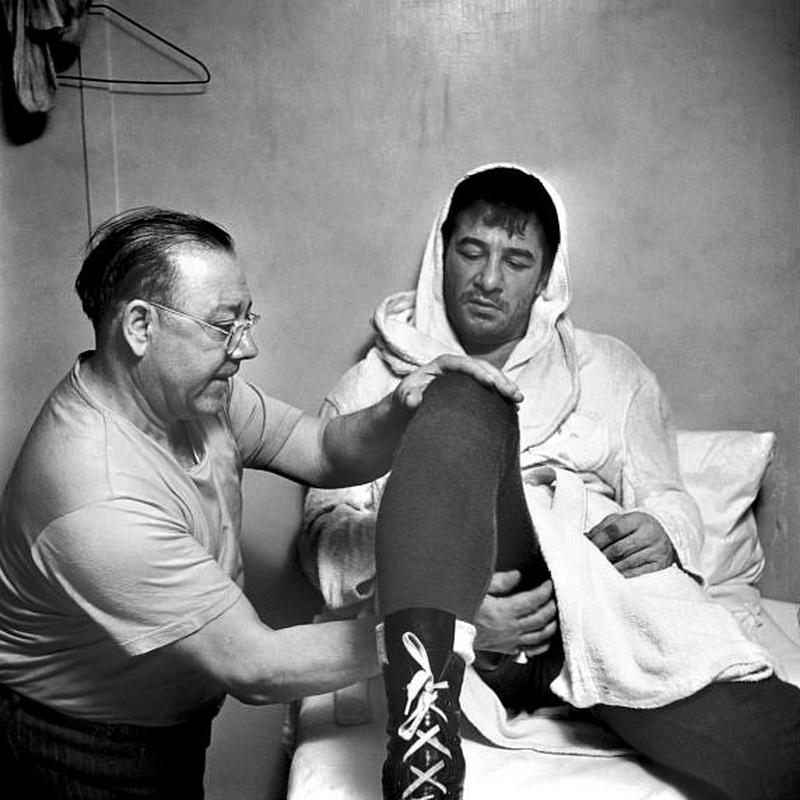
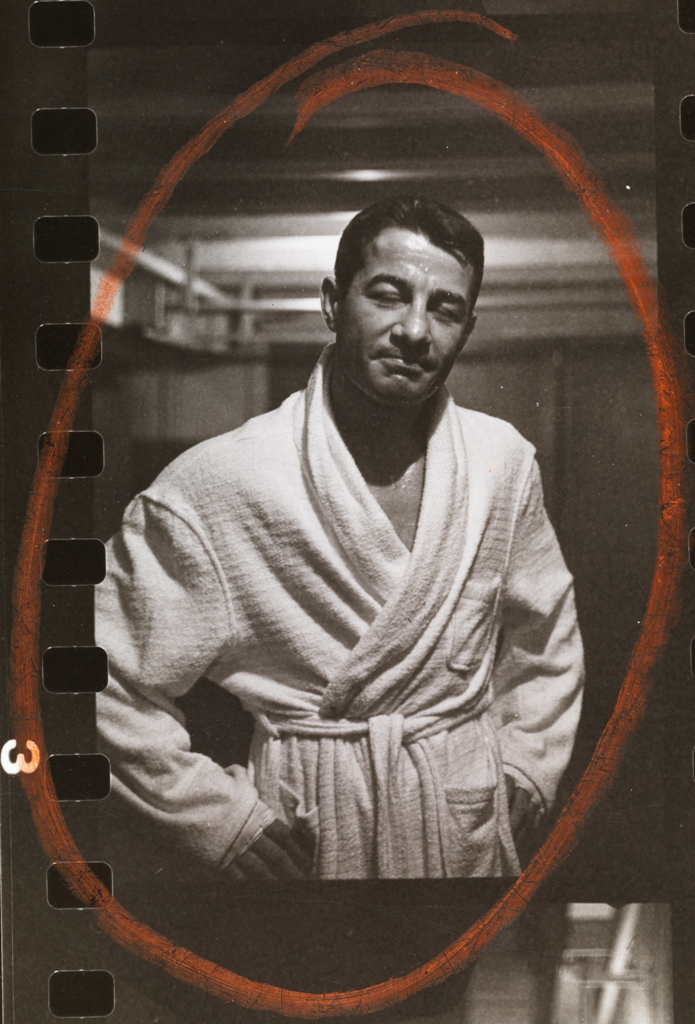
Heavyweight boxer Rocky Graziano (1919-1990), the greatest knockout artist in boxing history, photographed by filmmaker Stanley Kubrick.
I Highly recommend you watch this fascinating short film:

Thomas Rocco Barbella (1919 – 1990), better known as Rocky Graziano, was an American boxer. Graziano was considered one of the greatest knockout artists in boxing history, often displaying the capacity to take his opponent out with a single punch. He was ranked 23rd on The Ring magazine list of the greatest punchers of all time.


Rocky Graziano eating breakfast with his family.
Rocky Graziano playing cards with the boys
Stanley Kubrick (1928-1999).Rocky Graziano, He’s a Good Boy Now. Man applying petroleum jelly to Rocky Graziano.1949-1950. 

Rocky Graziano exercising. 

Stanley Kubrick's "Day of the Fight" - Part 1


 Stanley Kubrick's Boxer photographs
Contact sheet from Kubrick's first film

Stanley Kubrick (1928-1999). Walter Cartier – Prizefighter of Greenwich Village Walter Cartier during a fight.1948. 


Walter Cartier – Prizefighter of Greenwich Village Walter Cartier at a punching bag as Vincent Cartier and two other men watch.1948.
Walter Cartier eating in a restaurant and enjoying a good book. 1948

Walter Cartier was born in the Bronx in 1922. He started boxing with his brothers at an early age (his twin brother Vincent would later be his trainer) and after World War II gained prominence  in boxing circles in New York City.  At the time that Kubrick shot the LOOK story, Cartier was a 24-year old rising fighter, known for being a precise, smart, intense middleweight boxer.  The article accompanying the photographs says that if, “the big purses elude him another year, he plans to quit the ring and attend law school.”  But the big fights came and for years he was constantly on the cusp of becoming the middleweight champion.  As an obituary reads, “Cartier was that handsome Bronx knockout kid who sold tickets. Here was a special kind of a fighter–clean living, loved being a boxer and always kept himself in shape.”


You have read this article black and white / boxer / cinematic photography / Medium Format / Portrait / Rocky Graziano / Sports Photographer / Stanley Kubrick with the title . You can bookmark this page URL https://nikiinwonderland.blogspot.com/2012/11/never-before-seen-contact-sheets-from.html. Thanks!
Related Posts Plugin for WordPress, Blogger...